Which Flowers Press Best (and Which Don't)
Pressing works by squeezing the moisture out of a flower while holding it flat. The less water and bulk a bloom has, the better it presses. Flat-faced, thin-petalled flowers are the naturals; thick, watery ones fight you the whole way.
- Press beautifully: pansies, violets, cosmos, daisies, larkspur, delphinium, ferns and most leaves
- Press well with prep: roses and peonies (split them or press petals individually), hydrangea florets, lavender sprigs
- Struggle: succulents, orchids, lilies and anything fleshy - too much water, they brown and mould
- Golden rule: press at peak freshness, ideally the day you get them, before any petals wilt
Colour tip: blues, purples and pinks hold their colour best. Whites tend to go cream, and deep reds darken toward burgundy - still pretty, just plan for it.
Looking for the right words? Our card messages and wishes give you lines you can copy straight onto the card.
Method 1: The Book Press (Best Results)
The classic for a reason. You need a heavy book, plain paper (printer paper, coffee filters or parchment - not paper towel with texture), and patience.
- Open a heavy book and line a page with plain paper
- Arrange flowers face-down, not touching, and cover with a second sheet
- Close the book, stack more books or a brick on top
- Leave 2-4 weeks in a dry room; change the paper after the first week for thick blooms
The slow squeeze is what preserves colour and keeps petals from wrinkling. If a keepsake matters - wedding flowers, a memorial rose - use this method and give it the full month.
Method 2: The Iron (Same Day)
Need a pressed flower today? An iron gets you 90% of the way in minutes.
- Pre-flatten the flower inside a folded sheet of parchment under a book for 10 minutes
- Set the iron to low, no steam - steam is the enemy
- Press the iron onto the parchment for 10-15 seconds, lift, let it cool, repeat 3-4 times
- Stop when the flower feels papery and dry
Colours come out slightly less vivid than the book method, and very thick flowers stay a bit dimensional - fine for cards, less ideal for framing.
Method 3: The Microwave (Fast and Surprisingly Good)
Microwave pressing dries the flower before it can brown, which actually preserves colour better than the iron. You can buy a microwave flower press, or improvise with two ceramic tiles and paper.
Sandwich the flower in plain paper between the tiles, microwave in 30-second bursts on medium, letting it cool between bursts. Most flowers are done in 2-4 rounds. Finish with a day under a book to set them perfectly flat.
Method 4: A Wooden Flower Press
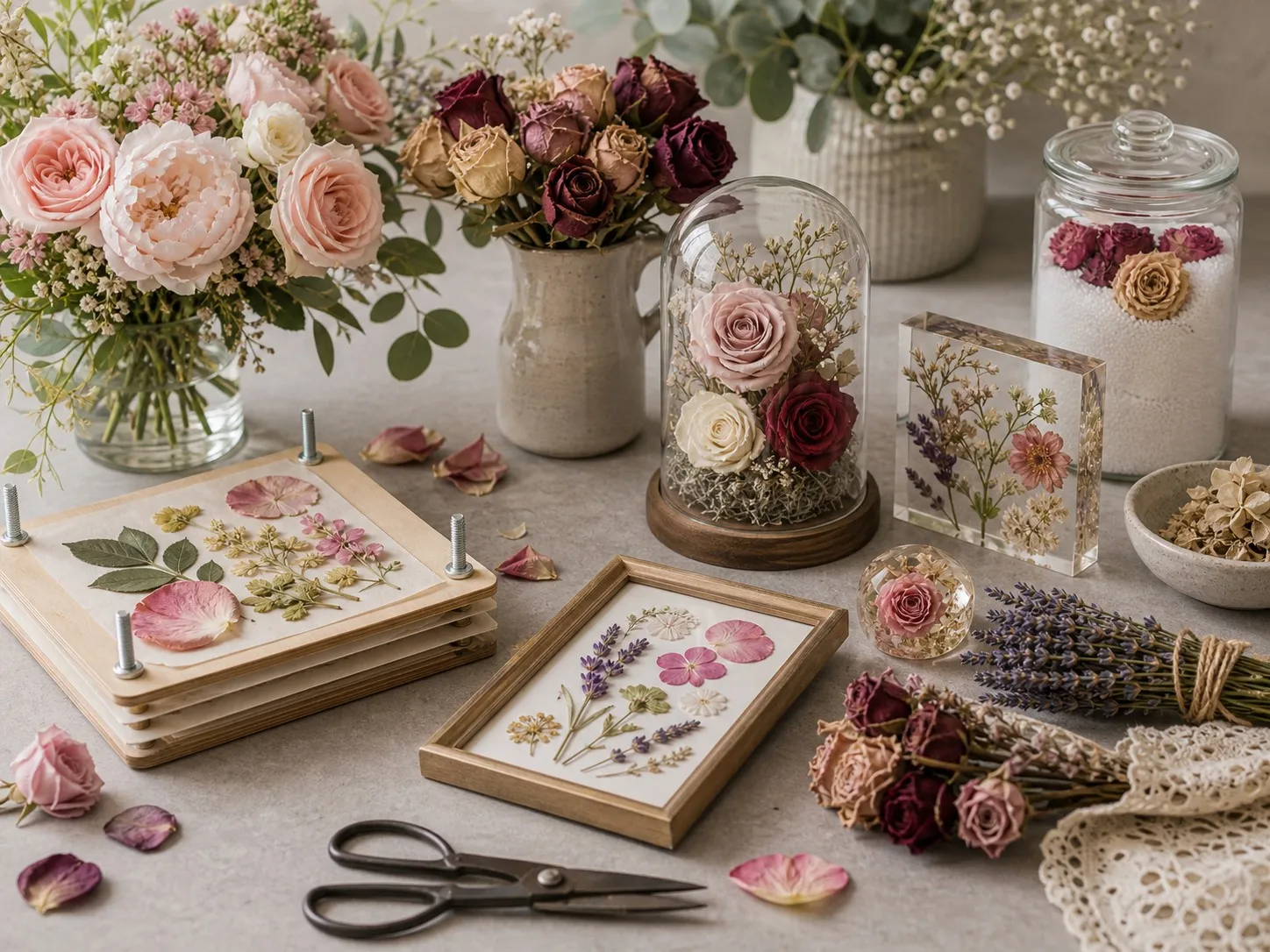
The dedicated tool: two wooden boards, cardboard and blotting-paper layers, and wingnut screws you tighten over time. It works exactly like the book method but presses harder and holds more flowers per batch - worth it if pressing becomes a habit. Timing is the same 2-4 weeks; tighten the screws a quarter-turn every few days as the flowers thin out.
Quick Comparison
| Method | Time | Colour | Best for |
|---|---|---|---|
| Heavy book | 2-4 weeks | Excellent | Keepsakes, framing, wedding flowers |
| Iron | 15 minutes | Good | Cards and crafts today |
| Microwave | 10 minutes + a day | Very good | Fast results with strong colour |
| Wooden press | 2-4 weeks | Excellent | Big batches, regular pressing |
What to Do With Pressed Flowers
- Frame them between two panes of glass for a float-frame botanical print
- Laminate a bookmark or seal them under clear phone-case resin
- Decorate wedding invitations, place cards and thank-you notes
- Make a memory page: press a flower from every bouquet of the year with a date underneath
- Seal onto candles or coasters with decoupage glue
Store spare pressed flowers flat between paper in a dry box, out of direct sun - they keep for years. Sunlight is the only real enemy: it fades pressed colour in months, so hang frames away from south-facing windows.
And when you are ready to send something, browse fresh flowers and add your note at checkout.