
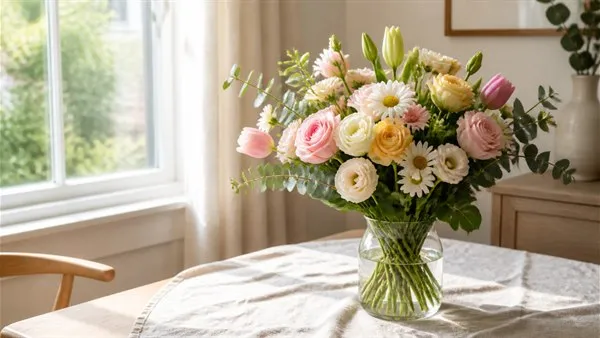
Why Most Bouquets Wilt Faster Than They Should
Cut flowers are still living tissue. From the moment the stem is cut, the flower is trying to drink water through a wound that wants to close up. Air bubbles in the stem, bacteria in the vase, and water that is too warm or too cold all interrupt that process.
Most of the "tricks" that get passed around online — the penny in the vase, the aspirin, the splash of vodka — are trying to solve one of those three problems. Some of them work a little. Most of them are not worth the effort. The basics are what move the needle.
Looking for the right words? Our card messages and wishes give you lines you can copy straight onto the card.

Re-cut the Stems the Moment You Get Home
This is the single highest-leverage step in the entire process. Stems start sealing over within minutes of being cut. If a bouquet has been wrapped at the shop, then driven across town, then sat on the kitchen counter for two hours, those stems are already mostly closed. The flower cannot drink even if the vase is full.
Use sharp scissors or a knife. Dull scissors crush the stem and make the problem worse. Cut about 2 cm off the bottom at a 45-degree angle. The angle gives the stem more surface area to pull water through, and it stops the cut end from sitting flat against the bottom of the vase.
Do this every time you change the water. Stems re-seal within a day or two, so a quick fresh cut every other day keeps the flower drinking.
- Sharp scissors or a knife — not dull kitchen shears
- Cut at a 45-degree angle
- Take off 1-2 cm of stem every time you refresh the water
- Strip any leaves that would sit below the waterline
What to Put in the Water (And What to Skip)
The flower food packet that comes with most bouquets does three things at once: it feeds the flower with sugar, it lowers the pH of the water so the stem can drink more easily, and it kills the bacteria that clog the stem. If you have the packet, use it. It is genuinely good. One packet is calibrated for about 500 ml of water, so split it across changes rather than dumping it all in on day one.
If you do not have flower food, the closest DIY version is one teaspoon of sugar, a small splash of clear vinegar or a few drops of lemon juice, and a tiny drop of plain bleach. Sugar feeds. Acid helps drinking. Bleach kills bacteria. Use about a quarter teaspoon of bleach for a full vase — much less than you would think.
Aspirin, pennies, and vodka mostly do not help. Aspirin lowers pH slightly but is unreliable. Pennies have not been pure copper since the 1980s. Vodka stresses the flower without giving it anything useful. The classic 7-Up trick does work, because it is sugar and acid in one — but use it diluted (about 1 part 7-Up to 3 parts water) or it will get sticky.
- Use the flower food packet if you have one — it is calibrated and it works
- DIY: sugar + a drop of vinegar or lemon + a tiny splash of bleach
- Skip aspirin, pennies, vodka — not worth the effort
- If you use 7-Up, dilute it heavily

Where to Keep the Vase
The placement of the vase matters more than most people realize. Direct sunlight, heat from a vent or a radiator, and the airflow from a window or a fan all speed up wilting. So does sitting next to a bowl of ripening fruit — fruit gives off ethylene gas, which makes flowers age faster.
The best spot is somewhere bright but indirect, cool, and out of the path of moving air. A side table away from the window is usually better than the windowsill. The kitchen counter is fine as long as the fruit bowl is on the other side of the room.
In Canadian apartments in winter, the dry forced-air heat is the real enemy. If the flowers are sitting under a heat vent, move them. Even a few feet of distance makes a noticeable difference.
- Bright but indirect light
- Cool room — away from radiators, vents, and direct sun
- Not next to ripening fruit (especially bananas, apples, tomatoes)
- Away from drafty windows and fans
Change the Water Every Two Days
This is the part most people skip, and it is the second biggest factor after the stem cut. Water in a vase gets cloudy within 48 hours because bacteria are growing in it. Once the water is cloudy, the stems are pulling that bacteria up into the flower. From there the bouquet has maybe 24 hours before it visibly drops.
Empty the vase fully. Rinse it with warm water and a drop of dish soap if there is any film on the inside. Refill with fresh cool water. Add fresh flower food. Re-cut the stems before they go back in.
This takes about three minutes. It is the difference between a bouquet that lasts 4 days and a bouquet that lasts 10.

Reviving Flowers That Already Look Tired
If a bouquet has wilted earlier than you wanted, it is usually possible to bring it back partway — especially if the heads are drooping but the petals still look healthy. Drooping is almost always a water-uptake problem, not a death sentence.
Re-cut every stem aggressively — take a full 3-4 cm off. Fill the sink or a deep bowl with cool water. Lay the whole bouquet on its side, fully submerged, for 30-60 minutes. Then put it back in a fresh vase with fresh water and flower food.
Roses respond especially well to this. Tulips and hydrangeas also bounce back. Daisies and chrysanthemums are more stubborn, but worth trying.
What you cannot fix: flowers whose petals have gone translucent, brown at the edges, or papery. That is the actual end of the cycle, and no amount of fresh water will bring them back.
How Long Different Flowers Actually Last
Bouquet longevity depends as much on the variety as on the care. Here is a realistic range for common flowers given proper care:
- Roses: 7-10 days, sometimes 14 if the heads were tight on arrival
- Tulips: 5-7 days — and they keep growing in the vase, so expect movement
- Lilies: 8-14 days, especially with the buds opening sequentially
- Hydrangeas: 5-10 days, very sensitive to water
- Carnations: 10-14 days, one of the longest-lasting cut flowers
- Chrysanthemums: 10-14 days
- Sunflowers: 7-10 days
- Peonies: 5-7 days — short window but worth it
- Daisies: 7-10 days
And when you are ready to send something, browse fresh flowers and add your note at checkout.


